
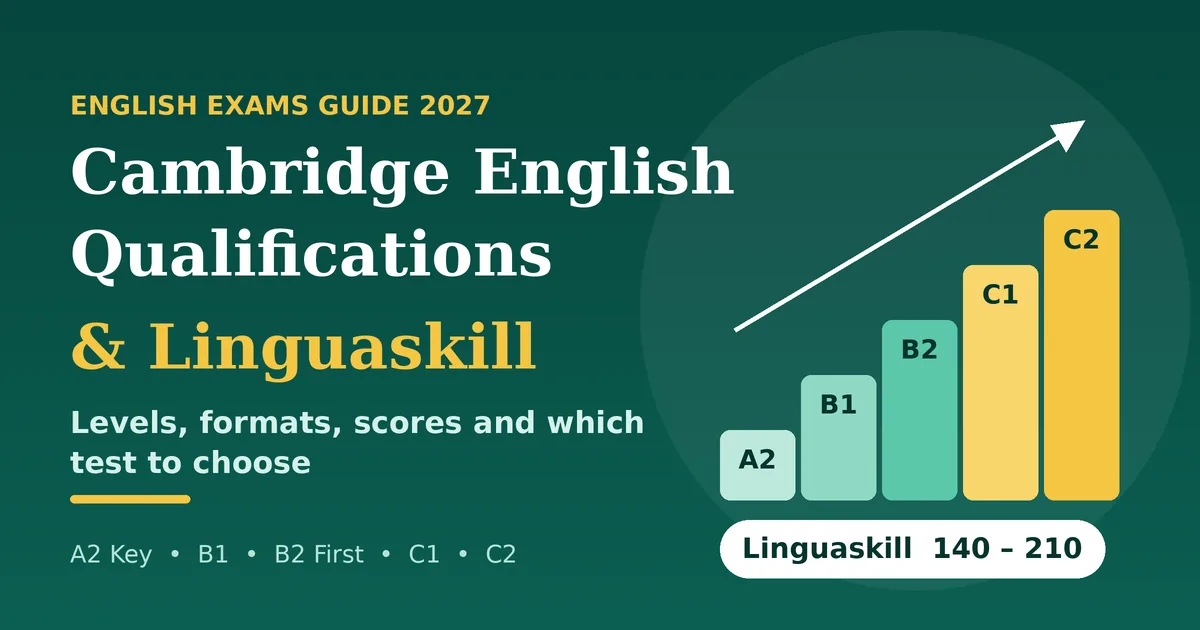
When a university, employer or school asks for proof of your English, the choice of test can feel confusing. Cambridge English qualifications and Linguaskill are two of the best-known options, but they work very differently. One is a traditional certificate exam taken on a fixed date, and the other is a flexible, adaptive online test with fast results. This guide explains Cambridge English qualifications and Linguaskill in plain language, so you can understand the levels, formats and scores and choose the one that fits your goal.
Table of Contents
- What Are Cambridge English Qualifications?
- Understanding CEFR Levels and the Cambridge English Scale
- The Main Cambridge English Qualifications: A2 Key to C2 Proficiency
- Exam Format of Cambridge English Qualifications
- How Cambridge English Qualifications Are Graded
- What Is Linguaskill?
- Linguaskill Format and Modules
- Linguaskill Scores and Results
- Cambridge English Qualifications vs Linguaskill
- Cambridge English Qualifications vs IELTS
- Who Accepts These Tests?
- Fees, Registration and Exam Dates
- How to Prepare
- A Simple 8-Week Study Plan
- Common Mistakes to Avoid
- Frequently Asked Questions
- Final Thoughts
What Are Cambridge English Qualifications?
Cambridge English qualifications are internationally recognised English exams developed by Cambridge University Press and Assessment. Each exam targets a specific level on the Common European Framework of Reference for Languages, known as CEFR, and each one tests the four skills of reading, writing, listening and speaking. Many people know them by their older names, such as KET, PET, FCE, CAE and CPE.
Unlike a single test that gives a general score, Cambridge English qualifications are separate exams at separate levels. You choose the exam that matches your current level or your goal. The official starting point is the Cambridge English website, where you can find exam information, preparation material and a way to look up recognising organisations.
Schools, language centres and employers use them widely. Many learners also like them because the certificate does not carry the same short expiry period that some other English tests have, although the organisation asking for it can still set its own limit on how recent your result must be.
Understanding CEFR Levels and the Cambridge English Scale
The CEFR is an international standard for describing language ability on six levels, from A1 for beginners to C2 for people who have mastered a language. You can read the official description on the Council of Europe website.
Cambridge English also reports results on its own Cambridge English Scale. The scale lets you see your exact score for each skill, not just a pass or fail.
| CEFR level | Meaning | Cambridge English qualification |
|---|---|---|
| A2 | Basic user | A2 Key |
| B1 | Independent user, lower | B1 Preliminary |
| B2 | Independent user, upper | B2 First |
| C1 | Proficient user | C1 Advanced |
| C2 | Mastery | C2 Proficiency |
The Main Cambridge English Qualifications: A2 Key to C2 Proficiency
A2 Key
A2 Key shows that you can use English for simple, everyday communication. It suits beginners and learners who want a first official certificate. A version called A2 Key for Schools is designed for school-age learners.
B1 Preliminary
B1 Preliminary shows that you can handle everyday English at an intermediate level, such as understanding the main points of clear texts and writing simple connected text. It is popular with learners who are building toward university or work.
B2 First
B2 First is one of the most popular Cambridge English qualifications. It shows that you can use English confidently for study and work, and Cambridge recommends it for foundation programmes, technical and vocational courses and courses taught in English. Results at this exam can also show ability at the level above or below.
C1 Advanced
C1 Advanced is targeted at an advanced level and is widely used for undergraduate and postgraduate admissions and professional work. The exam gives reliable results at C1, and can also show ability at C2 or B2.
C2 Proficiency
C2 Proficiency is the highest level and shows that you can use English with the fluency and precision of a very competent speaker. It is used for demanding academic study, including postgraduate and PhD programmes, and for senior professional roles.
Cambridge also offers young learner exams and business-focused qualifications, though this guide concentrates on the general and academic exams most adults and applicants take.
Exam Format of Cambridge English Qualifications
Each exam has papers that test all four skills. The exact structure varies by level and can change when Cambridge updates an exam, so always check the current format on the official site.
| Paper | What it tests | Typical content |
|---|---|---|
| Reading and Use of English | Vocabulary, grammar and reading | Gap-fills, word formation, multiple choice and comprehension tasks |
| Writing | Written communication | Essays, emails, reviews, reports or proposals, depending on level |
| Listening | Understanding spoken English | Conversations, talks and interviews |
| Speaking | Spoken interaction | A face-to-face conversation with an examiner, often with another candidate |
Higher-level exams are longer. For example, B2 First, C1 Advanced and C2 Proficiency usually take several hours in total, while lower-level exams are shorter. Many Cambridge English qualifications can be taken on paper or on computer, depending on the centre and country.
The Speaking test is usually taken in pairs or small groups, which many candidates find natural, because you speak with a partner as well as the examiner.
How Cambridge English Qualifications Are Graded
Cambridge English qualifications do not simply give a single pass-fail mark. Each skill receives a Cambridge English Scale score, and you receive an overall score and a grade. For example, B2 First reports results across the B2 range and can show a C1 grade for very strong performances. C1 Advanced can similarly show a C2 grade for the strongest candidates.
You can see the score bands on the official results pages, such as the Cambridge English results guide for A2 Key to C2 Proficiency. Candidates who score just below the target level may still receive a Statement of Results, but not a certificate.
Because scores are shown per skill, you can see exactly where you are strong or weak, which helps if you plan to retake the exam or choose a different level.
What Is Linguaskill?
Linguaskill is a different kind of Cambridge test. It is an online English test designed for quick, flexible assessment of reading, writing, listening and speaking. According to Cambridge English, it uses computer-adaptive technology and artificial intelligence, so the questions adjust to the candidate’s level, and it reports ability from B1 to C2 on the CEFR.
Organisations use Linguaskill for admissions, course placement, recruitment, progress checks and graduation requirements, and it can be taken at an approved test centre, at a school or company venue, or, in some places, remotely under supervision. Individuals can also take it where a centre offers it.
The main appeal of Linguaskill is speed and convenience. Reading and Listening results are produced immediately, and all skills are reported within about 48 hours, with no wait for a printed certificate.
Linguaskill Format and Modules
The current version of Linguaskill uses four modules: Reading, Listening, Writing and Speaking. This replaced an earlier version that combined Reading and Listening in one module. Organisations can often choose which modules to use, so one candidate might take all four while another takes only Writing and Speaking.
| Module | Adaptive? | How it is marked |
|---|---|---|
| Reading | Yes | Automatically, with instant results |
| Listening | Yes | Automatically, with instant results |
| Writing | Task-based | Marked by AI, with human review where used |
| Speaking | Task-based | Marked by AI, with human review where used |
The adaptive design means the test selects questions based on your answers, so you only see questions near your level. That can make the test shorter and more precise.
Linguaskill Scores and Results
Linguaskill reports on the Cambridge English Scale. Current information from Cambridge English states that the test assesses ability from B1 to C2 on the CEFR, with scores as follows.
| Cambridge English Scale score | CEFR level |
|---|---|
| 200 to 210 | C2 |
| 180 to 199 | C1 |
| 160 to 179 | B2 |
| 140 to 159 | B1 |
Candidates receive a certificate with detailed reporting for each module taken, plus an average score for the modules where they score B1 or higher. See the official Linguaskill results page for the latest details.
According to Cambridge English, a Linguaskill certificate does not expire. However, the organisation that asks for your result can choose how recent it must be, so confirm that with your university or employer.
Older versions of Linguaskill reported a wider range of scores, from below A1 up to C1 or above, so you may still see older charts online. If you took the test before the update, check the version shown on your report.
Cambridge English Qualifications vs Linguaskill
The two options suit different needs.
| Feature | Cambridge English qualifications | Linguaskill |
|---|---|---|
| Type | Separate certificate exams for each level | One adaptive test across B1 to C2 |
| Booking | Fixed exam sessions at approved centres | Flexible sessions at centres, schools or companies |
| Results | Statement of Results and certificate after marking | Fast, usually within 48 hours |
| Speaking | Face-to-face with an examiner | Taken on computer |
| Best for | Study, long-term proof of level, school and exam preparation | Placement, recruitment, quick checks and some admissions |
| Level choice | You choose the exam level | The test adapts to your level |
Cambridge English qualifications are usually better when you need a recognised certificate for admission or a long-term record, while Linguaskill is often better when you need a fast, flexible result or your institution specifically accepts it. Whichever you consider, check with the organisation that requests the result before you register.
Cambridge English Qualifications vs IELTS
Cambridge also helps to produce IELTS, but IELTS is a separate test with band scores from 0 to 9. IELTS is widely used for university admission and immigration, while Cambridge English qualifications are often used by schools, language centres and universities that accept them. Cambridge English publishes comparison tools so you can see how Cambridge English Scale scores relate to IELTS and CEFR levels. A comparison is a guide only, and each institution decides what it accepts.
Who Accepts These Tests?
Acceptance varies by country, institution and purpose. Cambridge English says that thousands of universities, employers and government departments recognise its exams, but you must check the specific requirement of the organisation you are applying to. Immigration authorities often accept only certain approved tests. For UK visa purposes, for example, the Home Office keeps its own list of approved English language tests, and not every Cambridge exam is on it. Never assume that a test accepted by a university is also accepted for a visa.
Before you pay, ask:
- Is this exact test accepted for my purpose?
- What minimum overall and skill scores are required?
- How recent must the result be?
- Do I need a certificate or will an online report be enough?
Fees, Registration and Exam Dates
Fees for Cambridge English qualifications and Linguaskill vary by country, centre and test type, so there is no global price. Use the official Cambridge English website to find an authorised centre near you, then ask the centre for its current fee, dates and registration rules. Be careful with unofficial websites and agents who promise guaranteed results or sell exam papers, because genuine test providers do not sell results.
For Cambridge English qualifications, register well before the exam date, because centres set closing dates. For Linguaskill, ask the centre or organisation how booking works, since sessions are often arranged by institutions.
How to Prepare
For Cambridge English qualifications
- Choose the right level. Take a free online level check and ask a teacher before you book.
- Learn the format of each paper and practise each task type.
- Read widely, including news, articles and fiction, to build vocabulary and use of English.
- Practise writing different text types, such as essays, emails and reports, and get feedback.
- Practise speaking with a partner, because the Speaking test often involves interaction.
- Take timed practice papers to build stamina for the longer exams.
For Linguaskill
- Practise with official sample tests to get used to the adaptive style.
- Improve your typing speed and accuracy for the Writing module.
- Practise speaking clearly into a microphone and answer in full sentences.
- Work on a wide range of topics, since the test adapts to your level.
- Check your equipment and internet connection if you take it remotely.
A Simple 8-Week Study Plan
- Weeks 1 and 2: Take a level check, learn the exam format and set a target score.
- Weeks 3 and 4: Focus on your weakest skill and learn key vocabulary and grammar patterns.
- Weeks 5 and 6: Practise timed tasks, write regular texts and speak with a partner or tutor.
- Week 7: Complete full practice papers or a full Linguaskill sample, then review every mistake.
- Week 8: Light review, rest and test-day preparation.
Use official Cambridge English materials whenever you can, because they reflect the current tasks and scoring more accurately than unofficial guides.
Common Mistakes to Avoid
- Choosing an exam that is too hard or too easy for your current level
- Registering before checking that the test is accepted
- Using outdated books that describe an old exam format
- Ignoring the Speaking and Writing papers because they feel harder to practise
- Waiting until the last minute to book a centre
- Paying unofficial sellers for papers or guaranteed results
Frequently Asked Questions
What are Cambridge English qualifications?
They are English exams from Cambridge University Press and Assessment, such as A2 Key, B1 Preliminary, B2 First, C1 Advanced and C2 Proficiency, each aligned to a CEFR level.
What is Linguaskill?
Linguaskill is an online, adaptive English test from Cambridge that measures reading, writing, listening and speaking from B1 to C2 on the CEFR and gives results quickly.
How long does it take to get Linguaskill results?
Cambridge English states that Reading and Listening results are instant and that results for all skills are available within about 48 hours.
Do Cambridge English certificates expire?
Cambridge English says that Linguaskill certificates have no expiry date, but organisations decide how recent a result must be. Check the policy of the institution that asks for your result.
Which is better for university admission?
It depends on the institution. Some prefer or require a specific Cambridge English qualification, others require IELTS or another test, and some accept Linguaskill. Always check the admissions page.
Can Linguaskill be used for a visa?
Do not assume so. Visa authorities usually accept only approved tests, so confirm directly with the immigration authority before you book anything.
What is the Cambridge English Scale?
It is a scoring scale used by Cambridge English to report results consistently across exams and levels, aligned to the CEFR.
Is C1 Advanced hard?
It is a demanding exam, but it is designed for advanced learners. With the right preparation, many candidates at a strong upper-intermediate level reach it.
Final Thoughts
Cambridge English qualifications and Linguaskill both offer trusted ways to prove your English, but they serve different needs. Choose Cambridge English qualifications if you want a certificate at a specific level and a long-term record of your achievement. Choose Linguaskill when you need a fast, flexible and adaptive result that your institution accepts. Before you register, confirm the exact test, level and minimum scores with the organisation asking for them, then practise with official materials. With the right choice and steady preparation, Cambridge English qualifications can help you move confidently toward your study or career goals.
Disclaimer: This article is for general information only. Exam formats, fees, scoring and acceptance rules are set by Cambridge University Press and Assessment and by the organisations that receive your results and can change without notice. Always verify details on official websites. This site is not affiliated with Cambridge University Press and Assessment, and it does not use any official Cambridge logos.
