
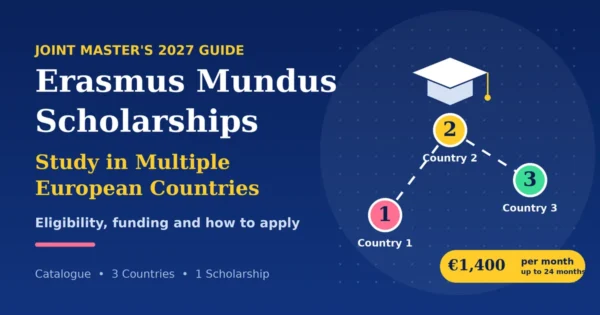
What if one master’s degree could take you to two or three European countries, give you a joint or multiple degree and pay for most of it? That is the idea behind Erasmus Mundus scholarships. They are funded by the European Union and attached to Erasmus Mundus Joint Masters, which are international master’s programmes run by groups of universities. This guide explains how Erasmus Mundus scholarships work, what they pay, who can apply, how to find programmes in the official catalogue and how to prepare an application that stands out for the 2027 and 2028 intakes.
Table of Contents
- What Are Erasmus Mundus Scholarships?
- How a Joint Master’s Lets You Study in Multiple Countries
- Erasmus Mundus Scholarships vs Erasmus+ Exchange
- What Erasmus Mundus Scholarships Cover
- Who Can Apply? Eligibility Requirements
- How to Find Programmes in the Catalogue
- How Many Programmes Can You Apply To?
- Erasmus Mundus Application Deadlines for 2027
- Documents You Need
- How to Apply: Step-by-Step
- How to Write a Strong Motivation Letter
- How Selection Works
- Studying Without the Scholarship
- Life Across Several Countries: Visas, Housing and Budget
- Tips to Improve Your Chances
- Common Mistakes to Avoid
- Frequently Asked Questions
- Final Thoughts
What Are Erasmus Mundus Scholarships?
Erasmus Mundus scholarships are EU-funded awards for students admitted to an Erasmus Mundus Joint Master, usually shortened to EMJM. An EMJM is a high-level master’s programme delivered by a consortium of at least three higher education institutions from at least three different countries. Students normally study in at least two of those countries during the programme and can finish with a joint degree, multiple degrees or a combination.
The programme is part of Erasmus+, and the scholarships are managed by the European Education and Culture Executive Agency, known as EACEA. The best place to start is the Erasmus+ website, which explains the scholarships and links to the programme catalogue.
Important point: you do not apply to one central office. You apply directly to the programme you want, using the consortium’s own website and rules. The scholarship is awarded through that programme’s selection process.
How a Joint Master’s Lets You Study in Multiple Countries
The big attraction of Erasmus Mundus scholarships is mobility. Instead of spending two years in one city, you might spend the first semester in one country, the second in another, a third semester in a third place and write your thesis somewhere else. Each programme sets its own route, so read the study plan carefully.
For example, a programme might begin in Germany, move to Spain for specialised courses and finish with a thesis in Finland. Another might include a placement with a partner organisation outside Europe. The exact countries and timing depend on the programme, and in many cases the route is fixed for everyone in the cohort.
This structure has clear benefits:
- You experience different academic cultures and teaching styles.
- You build an international network of classmates, professors and employers.
- You can pick up new languages and cultural skills.
- You graduate with a degree that shows adaptability and international experience.
It also has challenges. You will move more often, handle several residence permits, find housing more than once and manage your budget across different living costs.
Erasmus Mundus Scholarships vs Erasmus+ Exchange
People often confuse these two.
| Feature | Erasmus+ exchange | Erasmus Mundus Joint Master |
|---|---|---|
| Purpose | A semester or year abroad within your home degree | A full master’s degree taught by several universities |
| Where you study | Usually one host university | At least two countries, often three or more |
| Degree | Your home university degree | Joint, double or multiple degree |
| Funding | Partial monthly grant | Full scholarship for selected students |
| How to apply | Through your home university | Directly to the Erasmus Mundus programme |
If you are already enrolled at a university and want a short study period abroad, an exchange may be right. If you want a complete international master’s degree, Erasmus Mundus scholarships are the better match.
What Erasmus Mundus Scholarships Cover
The exact package depends on the programme and the current call, but published guides describe the following.
Participation costs
Scholarship holders do not pay tuition or other mandatory participation costs, and the programme’s insurance is included. The EU pays these costs directly to the consortium.
Monthly allowance
Recent guides report an allowance of about €1,400 per month for the length of the programme, up to 24 months, which equals up to €33,600 over two years. A 12-month programme would be about €16,800.
Travel, visa and installation
Sources are not consistent here, which is why you must read your programme’s official guide. Some guides say the monthly allowance must cover travel, visa and installation costs, while others describe separate travel and installation contributions, sometimes depending on the distance from your home country. Ask the programme coordinators exactly what applies to you.
Insurance
Scholarship holders are covered by the programme’s insurance, though you should check what it includes and any extra cover you may need.
All scholarship holders in a given call usually receive the same monthly amount, regardless of nationality. Because your allowance may have to cover moving between countries, build a budget that includes flights, deposits and temporary housing.
Who Can Apply? Eligibility Requirements
Eligibility has two layers: the general Erasmus Mundus rules and the extra rules of your chosen programme.
General requirements
- A bachelor’s degree or equivalent, or proof that you will complete it before the programme starts
- Admission to the programme through its own selection process
- Language skills required by the programme, usually English and sometimes another language
- No previous Erasmus Mundus Joint Master scholarship, because former holders generally cannot receive a second one
Programme-specific requirements
Each consortium may ask for a degree in a particular field, a minimum grade, work experience, a language test or additional documents. Some programmes also limit the number of scholarships that can go to one nationality, so competition can vary by country.
Residence rules
Older guidance linked some scholarship categories to where applicants had lived or worked in recent years. Current guides disagree on how this applies, with some saying that people with previous time in Europe can still apply. Do not rely on a blog post. Check the programme and the official call.
Nationality is rarely a barrier, because Erasmus Mundus scholarships are open to applicants from around the world, though a few special country-specific lots can exist.
How to Find Programmes in the Catalogue
The official EMJM catalogue lists every programme selected by the European Commission. Reports in October 2026 put the number at about 218 or 219 programmes covering fields such as engineering, environment, public health, journalism, human rights, data science and the arts.
Use the official EACEA Erasmus Mundus catalogue and follow these steps:
- Filter by subject and keywords, such as “sustainability” or “computer science”.
- Read each programme’s website, not just the catalogue summary.
- Check the study route: which countries, in what order and for how long.
- Note the language of instruction and any language requirements.
- Check the deadline, documents and selection process.
- Create a shortlist of three to five programmes.
Also check the number of scholarships offered, past cohort size and alumni outcomes if the programme shares them.
How Many Programmes Can You Apply To?
Many guides say you can apply to a maximum of three Erasmus Mundus programmes in one year and warn that going over this could disqualify you. At least one expert guide says the three-programme limit was dropped for programmes selected from 2019 onwards. Because this is a risk, check the rule on the programme and EACEA pages. As a practical approach, limit yourself to three high-quality applications, and write each one separately instead of sending the same letter everywhere.
Erasmus Mundus Application Deadlines for 2027
There is no single deadline. Each consortium sets its own, and many fall between October 2026 and January or February 2027 for September 2027 entry. Some programmes use several rounds, where an earlier round is meant for scholarship applicants and a later round for self-funded students.
| Period | What usually happens |
|---|---|
| Autumn 2026 | Applications open for many 2027 intakes |
| November 2026 to February 2027 | Most scholarship deadlines, varying by programme |
| Spring 2027 | Selection and interviews at many programmes |
| Summer 2027 | Offers, acceptance, visa applications and housing |
| September 2027 | Programmes typically begin |
An applicant applying now should open the catalogue today, note each programme’s date and prioritise the ones with the earliest deadlines.
Documents You Need
Each programme sets its own list, but most ask for:
- Completed online application form
- Passport copy
- Curriculum vitae, often in Europass or a similar format
- Motivation letter
- Academic transcripts and degree certificates, with translations if needed
- Language test results, such as IELTS, TOEFL or similar, if required
- Two or three recommendation letters
- Proof of work experience or research, where relevant
- Evidence of any special qualifications requested
Read our guides to the IELTS and TOEFL tests if you need an English test, and check whether your programme accepts alternatives such as the Duolingo English Test.
How to Apply: Step-by-Step
- Choose your field and goals. Decide what you want to study and what you want to do afterwards.
- Search the catalogue. Shortlist programmes that fit your degree and interests.
- Read the programme guide. Confirm eligibility, scholarship availability, deadlines and documents.
- Prepare your documents. Collect transcripts, language results and references early.
- Write a tailored motivation letter. Make a separate letter for each programme.
- Ask referees in advance. Give them at least four weeks and the full instructions.
- Apply on the programme’s website. Do not use an agent that charges fees to submit, and note that programmes should not charge application fees to scholarship applicants.
- Submit early. Do not wait for the last hour, because portals can be slow.
- Track your email. Check messages and spam folders for requests, interviews and results.
- Accept and plan. If you receive an offer, follow the acceptance instructions and begin your visa preparation.
How to Write a Strong Motivation Letter
Because many Erasmus Mundus applicants have strong grades, your motivation letter often decides who is chosen.
Include these points
- Why this programme: Mention the specific courses, universities and study route that attract you.
- Why a multi-country degree: Explain how studying in several countries helps your goals.
- Your background: Highlight projects, research, work and achievements with concrete results.
- Your plan: Describe what you will do after graduating and how you will use your skills.
- What you bring: Show how you will contribute to the cohort, such as skills, perspective or experience.
Writing tips
- Use clear, simple language and a logical structure.
- Avoid templates and flattery. Show evidence of your interest.
- Respect word limits and formatting rules.
- Ask a mentor or lecturer for feedback.
- Proofread carefully before submitting.
How Selection Works
Each consortium ranks applicants using its own criteria, which often include academic record, relevance of your background, motivation, references, language skills and sometimes interviews. After admission decisions, scholarships are given to the best-ranked applicants within the available number of places. Some programmes also set limits so that no single nationality receives more than a share of the scholarships.
Because scholarships are limited, you may be admitted but not funded. In that case the programme may offer a self-funded place, which is why it is important to understand costs before you accept.
Studying Without the Scholarship
If you are admitted but do not receive a scholarship, you can usually still join as a self-funded student, but you pay participation costs set by the programme. These can be significant, and each consortium sets its own fees. Look for other funding such as national scholarships, university awards or your home government’s programmes, and do not accept a self-funded place without a clear budget.
If your goal is a funded European master’s through a different route, read our guides to DAAD scholarships in Germany and to fully funded scholarships.
Life Across Several Countries: Visas, Housing and Budget
Studying in more than one country is exciting but needs planning.
Visas and residence permits
Many non-European students need a student visa for the first country and a residence permit, and then they may need to apply for permission to study in the next country. Coordinators usually help, but you must keep your documents ready. Start early and follow the official instructions of each country. The Study in Europe portal gives useful general information.
Housing
Student housing can be tight in popular cities. Ask the programme about accommodation support, apply early and avoid paying deposits to unverified landlords.
Budget
Create a budget for each country, because costs vary widely. Include rent, food, transport, phone, books, flights between countries and an emergency fund. If your monthly allowance must cover moves and visas, save as much as you can from the start.
Language and culture
Learn the basics of each country’s language, even if your classes are in English. It will help with daily life and make it easier to find part-time work or internships.
Tips to Improve Your Chances
Start early
Open the catalogue several months before deadlines and prepare documents in advance.
Choose the right programmes
Pick courses that match your degree, skills and goals. Apply where your profile is clearly competitive.
Customise each application
Every consortium reads many applications. A tailored letter that mentions the programme’s content and route stands out.
Show international readiness
Examples of adaptability, teamwork, language learning, volunteering or time abroad can help show that you will cope with multi-country study.
Get strong references
Choose referees who know your work and can give specific examples.
Keep everything consistent
Names, dates, grades and course titles should match across all documents.
Common Mistakes to Avoid
- Using outdated blog posts for deadlines and rules
- Applying to more programmes than the current rules allow
- Sending the same generic motivation letter to every consortium
- Ignoring the study route and moving costs
- Assuming every programme includes separate travel money
- Missing early scholarship deadlines
- Paying agents who promise guaranteed scholarships
- Leaving visa planning until the last minute
Frequently Asked Questions
What are Erasmus Mundus scholarships?
They are EU-funded scholarships for students admitted to an Erasmus Mundus Joint Master, a master’s programme delivered by universities in several European countries.
How much do Erasmus Mundus scholarships pay?
Published guides report no tuition or mandatory participation costs and a monthly allowance of about €1,400 for up to 24 months. Check your programme for how travel, visa and installation costs are handled.
Are Erasmus Mundus scholarships fully funded?
They are among the most complete master’s scholarships in Europe, but your allowance still has to cover real living and moving costs, so budget carefully.
Can I apply from any country?
Generally yes, because Erasmus Mundus is open to applicants worldwide, though individual programmes and scholarship lots may have extra rules.
Do I need IELTS for Erasmus Mundus?
It depends on the programme. Many ask for proof of English, but some accept an English-medium degree or other evidence.
Can I apply to more than one programme?
Many guides say up to three, though at least one expert source says the old cap was removed. Check the official rules and limit yourself to three strong applications to be safe.
When is the Erasmus Mundus deadline?
Each programme sets its own deadline, often between October 2026 and February 2027 for September 2027 entry.
Do I get a joint degree?
Programmes award joint, double or multiple degrees, depending on the consortium. Check the exact degree type before applying.
Final Thoughts
Erasmus Mundus scholarships make it possible to study in multiple European countries, earn an internationally recognised master’s degree and receive strong financial support. The key is to treat the process like a project: search the official catalogue, read each programme’s rules, prepare your documents early, write a tailored motivation letter for every application and plan your budget for moving between countries. Because deadlines and rules vary, confirm everything on the official Erasmus+ and EACEA websites. With a focused plan and honest, well-prepared documents, Erasmus Mundus scholarships can open a path to a truly European career.
Disclaimer: This article is for general information only. Erasmus Mundus programmes, scholarship amounts, eligibility rules and deadlines are set by the European Union and by each consortium and can change without notice. Always verify details on official websites before applying. This site is not affiliated with the European Union, EACEA or any university, and no strategy can guarantee an award. It does not use any official Erasmus+ or EU logos.